

25+ Questions to Ask Your Acumatica Partner Before Signing a Contract
Written by Pabian Partners Team
Published: May 2026
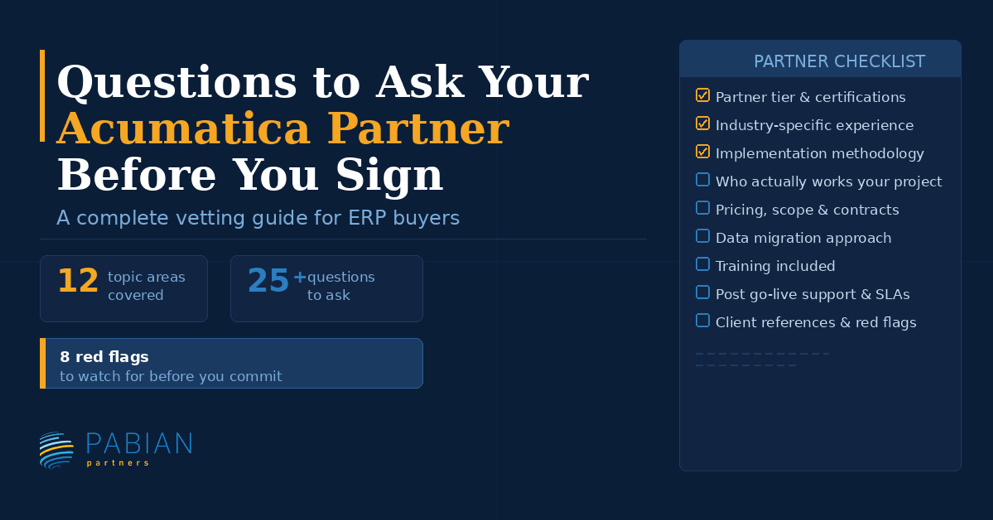
- 25+ Questions to Ask Your Acumatica Partner Before Signing a Contract
- Why the Partner Decision Matters More Than Most People Realize
- Partner Experience and Qualifications
- Industry Expertise
- Implementation Methodology
- Team Structure and Staffing
- Pricing, Contracts, and Scope
- Customization and Configuration
- Data Migration
- Training
- Post Go-Live Support
- References and Past Implementations
- Long-Term Relationship
- Red Flags to Watch For
- How Pabian Partners Approaches These Questions
- Final Thoughts
- FAQs
Key Takeaways
Key Takeaways
- Choosing the partner is just as important as choosing Acumatica.
The same ERP can produce very different results depending on the partner’ industry experience, implementation process, team capacity, and ability to understand how your business operates.
- Do not accept claims without asking for evidence.
Ask about the consultants assigned to your project, relevant certifications, similar implementations, customer references, testing methods, data migration experience, and projects that did not go according to plan.
- Clarify the entire relationship before signing the contract.
The proposal should clearly explain scope, exclusions, pricing, change requests, customization ownership, training, go-live support, response times, upgrades, and ongoing costs. A good partner will welcome these questions.
25+ Questions to Ask Your Acumatica Partner Before Signing a Contract
Choosing Acumatica is a smart decision for growing businesses. But choosing the right Acumatica partner is honestly the most important decision that determines whether your implementation succeeds.
Acumatica sells exclusively through a network of Value-Added Resellers (VARs). The company you sign with is not just a vendor. They are your implementation team, your configuration guide, your training resource, and your long-term support contact. There is no Acumatica professional services team that swoops in to rescue you if the relationship goes sideways. Your partner becomes your primary point of contact with the system, for better or worse.
Most businesses spend weeks comparing ERP platforms and nowhere near enough time vetting the people who are going to implement it. That’s a mistake we see often, and it’s an expensive one to correct after the fact.
This guide walks through every meaningful question you should ask an Acumatica partner before you sign, covering experience, methodology, staffing, pricing, customization, data migration, training, support, and long-term fit.
Why the Partner Decision Matters More Than Most People Realize
An ERP implementation isn’t a software installation. It’s an operational transformation.
The software gives you a framework, but the partner is the one who figures out how your business fits inside that framework. That’s a big job, and it requires real understanding of how you operate.
The same Acumatica license can produce dramatically different outcomes depending on who implements it. Partners with genuine industry experience build systems around how your business runs. Partners without that depth default to generic setups that end up creating workarounds and frustration six months after go-live.
Before you spend time evaluating any Acumatica partner on price or timeline, make sure you’re evaluating whether they understand your business and whether they have the experience and team to back you up through implementation and long after it.
The questions below are designed to help you make that assessment.
1.Partner Experience and Qualifications
- How long have you been an Acumatica partner?
Tenure matters, but it isn’t the only thing that matters. A partner who has been implementing Acumatica for eight years has seen more edge cases, more upgrade cycles, and more difficult client situations than someone who just completed their first certification. That said, a newer partner with deep ERP experience in your specific industry might serve you better than a long-tenured generalist who has never worked in your vertical. Ask about both longevity and relevance, because you need both. - What is your Acumatica partner tier?
Acumatica runs a tiered partner program. Higher tiers typically reflect demonstrated implementation volume, certified staff, and customer satisfaction scores. A partner’s tier is a rough signal of their commitment and track record within the ecosystem. It’s not the whole picture, but it’s a reasonable starting point. - How many Acumatica implementations has your team completed?
Total implementation count matters less than the character of those implementations. A partner who has completed 200 straightforward configurations may be far less equipped for your complex manufacturing environment than one who has done 30 deep, industry-specific deployments. Ask this question, then follow up with: How many of those were for businesses like mine? That follow-up is where you learn something useful. - Do your consultants hold current Acumatica certifications?
Acumatica certifications are module-specific and need to be renewed periodically. Verified, current certifications across Finance, Distribution, Manufacturing, and other modules relevant to your business confirm that the people working on your project understand the platform at a technical level. Ask which certifications the specific consultants assigned to your project hold, not just what the firm has overall. Those are two very different answers. - Have you implemented the specific Acumatica modules we need?
Acumatica is modular, and the skill sets differ meaningfully between modules. Implementing the Financial Management suite is a different job than implementing Manufacturing or Field Service. Make sure your partner has real, hands-on experience with the exact modules your business requires, not adjacent or related ones.
2. Industry Expertise
- How many clients in our industry have you implemented Acumatica for?
This is one of the most important questions on this entire list. ERP doesn’t operate in a vacuum. It must match how your industry works, and the nuances matter. A manufacturing business has production order workflows, bills of materials, work centers, and scheduling complexity. A distributor deals with multi-warehouse inventory, purchasing logic, and fulfillment scenarios that don’t always go cleanly. A professional services firm needs project accounting, resource management, and billing structures that are completely different from either of those.
Partners who haven’t implemented Acumatica in your industry will configure the system based on generic best practices rather than the operational realities you live with every day. That disconnect creates friction from the moment you go live.
- Can you show us examples of industry-specific configurations you have built?
Any partner can claim industry expertise. Ask them to demonstrate it. Request anonymized examples of how they’ve configured Acumatica for businesses in your vertical reporting structures, workflows, integrations, or custom screens that reflect real operational needs in your industry. Seeing actual work tells you far more than a sales conversation.
- What are the most common operational challenges businesses in our industry run into during ERP implementation?
A partner with genuine industry experience will answer this without hesitation. They’ve seen the same pain points repeat across multiple clients across inventory costing challenges, production scheduling complexity, regulatory reporting requirements, or fulfillment edge cases that most systems don’t handle cleanly out of the box. A partner who struggles to name anything specific is likely generalizing.
- Do you have case studies or testimonials from clients in our industry?
Written case studies and customer references from your industry are concrete evidence of relevant experience. When you ask for them, be specific. Ask for clients who were at a similar stage of growth and operational complexity when they implemented Acumatica with this partner. A case study from a two-person startup doesn’t tell you much if you’re running a 200-person distribution operation.
3.Implementation Methodology
- What does your implementation process look like from discovery to go-live? A clear, well-structured implementation methodology is one of the strongest signals of a competent partner. They should be able to walk you through each phase without hesitation: discovery, design, configuration, testing, training, and go-live. Partners who jump straight to configuration without doing proper discovery almost always build systems that don’t reflect how the business operates.At Pabian Partners, every engagement starts with a thorough discovery process. We get into the details of your current workflows, your pain points, your growth plans, and your operational edge cases before a single configuration decision gets made. If you want to understand what a well-structured Acumatica implementation looks like in practice, including realistic timelines by phase, our implementation guide walks through it in detail.
- How do you approach the discovery process? Discovery is the phase where the partner learns how your business runs. It should involve structured conversations with your team across departments including finance, operations, sales, warehouse, and IT. Ask how many hours of discovery they typically invest before moving into design, and who from their team leads those sessions. Shallow discovery is the single most reliable predictor of a configuration that misses the mark.
- Do you work with a fixed scope or a more flexible methodology? Both approaches come with real tradeoffs. Fixed-scope projects give you cost certainty but sometimes leave business requirements unaddressed if they fall outside the defined boundary. Flexible methodologies give you room to adapt as discovery reveals more complexity, but they require clearer governance to keep scope from quietly expanding. Understand which model the partner works with and how they protect both sides when requirements change mid-project.
- How do you handle scope changes once the project is underway? Scope changes are pretty much inevitable in complex ERP projects. The question is whether the partner handles them in a structured, transparent way or whether they let things slide until you get a surprise invoice. Partners with a clear change control process document what changed, get it priced and approved, and communicate it before doing the work. That’s the kind of process you want.
- What does your testing phase involve? Testing is where your configured system meets real business data and real workflows. A thorough partner runs unit testing on individual configurations, integration testing across modules, and user acceptance testing (UAT) where your own team validates the system against real scenarios before go-live. Ask specifically whether UAT is included and how much time they allocate for your team to participate in it. If testing is thin or rushed, you find out the hard way on day one.
- How do you manage go-live? Go-live is the highest-risk moment in any ERP project. Ask how the partner manages the cutover from your old system to the new one, whether they’ll be available in real time during that period, and what their plan looks like if something critical surfaces on day one. A strong partner has a go-live checklist, a stabilization plan, and defined support coverage for the first few weeks after launch. Going live without that structure is asking for trouble.
4.Team Structure and Staffing
- Who will be working on our project? This is a question far too many buyers forget to ask and then regret not asking. Some partners win business by putting senior consultants in the sales process and then hand the project off to junior staff after the ink is dry. Ask to meet the specific people who will be assigned to your implementation before you sign anything. If the team you meet during sales isn’t the team doing the work, you deserve to know that upfront.
- Will we have a dedicated project manager? ERP projects fail at the management layer just as often as they fail at the technical layer. A dedicated project manager who owns timelines, tracks open decisions, manages risk, and communicates proactively is essential for any implementation with real complexity. Ask whether project management is built into the partner’s engagement model or whether it’s billed as an add-on.
- What’s the ratio of consultants to active projects on your team right now? A small team stretched thin across too many simultaneous projects will struggle to give your implementation the attention it deserves. There’s no perfect benchmark here but understanding how many active projects each consultant is carrying helps you gauge whether your engagement will get the bandwidth it needs.
- What happens if our lead consultant leaves during the project? People leave jobs. It happens. The question isn’t whether turnover can occur; it’s whether the partner has a plan for handling it. Partners with documented processes, shared project notes, and a team-based delivery model are far more resilient to personnel changes than those who depend entirely on one consultant’s institutional knowledge. Ask directly how they’ve handled this in the past.
- Do you use subcontractors for any part of the implementation? Some partners subcontract portions of the work, whether that’s data migration, development, or specialized configuration. That’s not automatically a problem, but it does introduce accountability questions you need to understand. If subcontractors are involved, find out how the partner manages quality, communication, and continuity across the extended team.
5.Pricing, Contracts, and Scope
- How do you structure your implementation fees? Implementation pricing generally follows one of three models: fixed fee, time and materials, or a hybrid. Fixed-fee engagements give you cost certainty but require a well-defined scope to work properly. Time and materials are more flexible but need disciplined scope management to avoid ballooning costs. Understand which model the partner uses, why they prefer it, and how it protects you when things don’t go exactly as planned.Before this conversation, it helps you to understand how Acumatica licensing costs work so you can see the full picture of what you’re budgeting for. Our Acumatica ERP pricing guide breaks down licensing tiers, consumption factors, and common cost variables in plain language.
- What is and isn’t included in your quoted price? This matters more than almost anything else in the pricing conversation. Implementation quotes vary enormously in what they cover. Ask directly whether discovery, data migration, training, customization, third-party integrations, post go-live support, and travel are included or excluded. Partners who quote low numbers typically do so by leaving these things out, and those line items add up fast.
- Are there costs we should expect after go-live that aren’t covered in this proposal? Post go-live surprises are one of the most common grievances we hear from businesses that switched to us from another partner. Annual support fees, upgrade fees, additional training costs, and change request billing can add substantial ongoing cost that nobody mentioned during the sales conversation. Ask the partner to be specific about what you should budget for beyond the initial project.
- How do you handle travel and on-site time? If the partner charges for travel, understand exactly how that billing works. Some partners bill consulting rates for travel hours, which can meaningfully increase costs on longer engagements. If you expect or need on-site presence during critical phases like go-live, confirm whether that’s included or priced separately.
- What does your implementation contract look like? Read it carefully before you sign and consider having legal counsel review any significant engagement. Key items to look for include payment milestones tied to project phases rather than just calendar dates, a clear definition of what constitutes project completion, what happens if the project runs over timeline or budget, who owns any custom code and configurations built for your implementation, and what the termination clauses say.
6.Customization and Configuration
- How do you approach customization requests? Acumatica is highly configurable and the vast majority of business requirements can be met through configuration rather than writing custom code. Partners who default to customization for every unique requirement are creating technical debt that will complicate every future upgrade and drive up your long-term maintenance costs. A strong partner knows the difference between configuration (adjusting how the system behaves using built-in tools) and customization (writing code to extend the system), and they try hard to solve problems through configuration first. If you want to understand this distinction before your partner conversations, it’s worth reading about the difference between customizing ERP and configuring it so you can ask sharper questions and spot shortcuts early.
- What’s your philosophy on modifying out-of-the-box functionality? The best Acumatica partners start from the assumption that the standard system handles more than most businesses expect, and they configure around edge cases before they reach for custom development. Ask this question directly and pay attention to the answer. Partners who respond with something like “we build whatever you need” are optimizing for the sale, not for your long-term interest.
- How do your customizations hold up through Acumatica’s biannual upgrades? Acumatica releases two major updates every year. Customizations that weren’t built following Acumatica’s development framework can break during those upgrades, which means expensive rework every time you update. Ask the partner how they build customizations to survive upgrades and what their actual track record looks like when existing clients go through the upgrade process.
- Who owns the custom code developed for our implementation? This is a critical contract question and one that catches people off guard. Custom screens, workflows, and integrations built for your implementation should be owned by you, not the partner. If you ever decide to change partners, you need to take your configurations with you. Make sure this is explicitly stated in your agreement.
7. Data Migration
- What’s your approach to data migration? Data migration is consistently one of the highest-risk pieces of any ERP implementation, and how a partner approaches it tells you a lot about their experience level. Strong partners follow a structured process: data audit, cleansing, mapping, test migrations, validation, and final cutover. Partners who treat data migration as an afterthought or tack it on at the end of the project create serious problems at go-live.It’s worth understanding what goes wrong in data migration projects before you get into these conversations. Our article on what breaks ERP data migration projects covers the most common failure points and what to probe for when you’re evaluating a partner.
- What data will you migrate and what won’t you migrate? Not everything in your legacy system needs to come over, and some of it probably shouldn’t. Historical transactions, archived records, and years of duplicate entries can add a lot of noise without much value in the new system. Ask how the partner helps you make those decisions, and what tools or processes they use to execute the migration.
- How many test migrations do you typically run before go-live? Running a single migration test right before go-live is not enough. Strong partners run multiple test migrations early in the project so that data quality issues surface while there’s still time to address them properly. Ask how many test cycles are built into their process and who is responsible for validating the output.
- What happens if data quality problems turn up late in the project? Legacy system data is almost always messier than anyone expects going in. Duplicate records, inconsistent naming conventions, missing fields, and values that made sense five years ago but not anymore are just part of reality. Ask the partner how they handle data quality issues that surface late in the project and what the cost and timeline implications typically look like.
8. Training
- What training is included in your implementation engagement? Training is consistently underinvested in ERP projects, and it’s one of the leading reasons adoption suffers after go-live. Ask what’s included in the proposal: how many hours, in what format (in-person, virtual, recorded), and for which roles. Training a warehouse operator requires a completely different approach to training a financial controller, and both need to happen.
- Do you offer role-based training? Generic system walkthroughs don’t produce confident users. Role-based training teaches people exactly what they need to know to do their specific job in the new system, and it cuts out everything that isn’t relevant to them. Partners who invest in building role-specific training get faster adoption and fewer support calls in the months after go-live.
- Will training happen in our actual configured system or a demo environment? Training in a demo environment with sample data is significantly less effective than training in a sandbox version of your own configured system with your own data. People learn better when the screens in front of them match what they’ll use on day one. Ask whether training is built around your actual environment.
- Do you provide training documentation or recorded materials we can keep? Staff turnover. New employees join. Your ability to onboard people into your ERP system a year after go-live depends on having accessible training materials you actually own. Ask whether the partner provides written guides, recorded sessions, or reference documentation that your team can use independently, without involving the partner every time.
- What training resources does Acumatica itself provide? Acumatica Open University is free and offers self-paced, role-based training content across all modules. A good partner incorporates this into your training plan rather than charging you for content Acumatica already provides. Ask how they leverage those resources as part of the overall training approach.
9. Post Go-Live Support
- What support do you offer after go-live? Go-live isn’t the end of the engagement; it’s the beginning of a new phase. Questions come up, edge cases surface, configuration needs adjusting, and users run into situations nobody anticipated during testing. Ask the partner how their support offering is structured in the weeks and months after launch, not just during the project itself.
- What are your support SLAs? Service level agreements define how quickly a partner responds to different kinds of support requests. Ask for written SLAs that specify response times for critical issues like system outages or data integrity problems, and for non-critical requests like training questions or minor configuration adjustments. Vague commitments like “we’ll get back to you quickly” aren’t a real SLA.
- How do clients submit support tickets? The support intake process is a good indicator of how operationally mature a partner is. Partners with a dedicated support portal, defined ticket categories, and a named support contact or project manager handle ongoing client needs much more consistently with defined response timelines than those who route everything through emails and automated responses.
- Do you offer tiered support plans? Some partners offer different levels of coverage so clients can choose what fits their needs and budget. Base plans might cover critical issues, while premium plans include proactive system reviews, upgrade assistance, and dedicated consultant access. Understand what’s included in whatever is standard versus what costs extra.
- How do you handle Acumatica’s biannual upgrades for clients on support? Acumatica releases significant updates twice a year. Managing those upgrades properly means testing customizations, validating integrations, and communicating changes to users before the update goes live. Ask whether upgrade support is part of the ongoing plan and what that process looks like. Clients left to manage upgrades on their own tend to delay them, which creates a different set of problems down the road.
- What does your post go-live support team look like? Some partners are genuinely better at winning new implementations than at supporting existing clients. Ask how many clients the partner currently has on active support, how many staff members are dedicated to ongoing support work, and whether there’s continuity between the people who implemented your system and the people who will support it.
10.References and Past Implementations
- Can you provide references from clients in our industry? References are one of the most reliable ways to validate what a partner is telling you. Ask for two or three clients in your industry who are at least twelve months past go-live. That timeline matters because you want to hear from people far enough out that the initial excitement has settled and they’re living with the system in normal operational conditions.
- What questions should we ask your references? A confident partner won’t just hand you a list of names; they’ll suggest the most useful questions to ask. When you talk to references, ask how well the partner understood their business before implementation started, whether there were scope or budget surprises, how the partner handled problems when they came up, what the support experience has been like since go-live, and whether they would choose the same partner again. Those five questions tell you almost everything you need to know.
- Have any of your clients ever switched to a different Acumatica partner? This is a pointed question, and the partner’s response is informative no matter what they say. Client turnover happens for all kinds of reasons, and a partner who has lost a client or two isn’t automatically disqualified. But how they talk about it tells you a lot about their self-awareness and accountability.
- Can you walk us through a project that didn’t go smoothly and what you did about it? Every experienced partner has dealt with a difficult project at some point. Scope that grew beyond the original estimate, data migration that took longer than planned, or a client who wasn’t as prepared as expected. What matters isn’t whether those things happened; it’s how the partner responded. Partners who can talk honestly about hard projects and what they learned from them are far more trustworthy than those who claim a flawless record.
11.Long-Term Relationship
- How do you envision the relationship evolving after go-live? ERP is not a one-time purchase. Your business will grow and change, and the system needs to grow with it. New modules get added, integrations need updating, processes improve, and reporting requirements evolve. A partner who thinks about the relationship beyond the initial implementation will bring you more long-term value than one who closes the project and moves on to the next sale.
- Do you have an ongoing consulting practice separate from new implementations? Some partners focus almost entirely on new implementations and don’t have a structured practice for existing clients. Others have dedicated teams for post go-live optimization, process improvement, and system expansion. Ask which model this partner operates under, and whether they have the capacity to be a real long-term advisor rather than just a project vendor.
- How do you stay current with Acumatica updates and new features? Acumatica invests heavily in its product and ships meaningful new functionality twice a year. A strong partner attends Acumatica Summit, participates actively in the community, and proactively surfaces relevant new features to clients. Partners who aren’t engaged with the Acumatica ecosystem tend to fall behind, which means you miss improvements that could benefit your business.
- How do you handle situations where a client’s needs outgrow what your team can support? Growth can sometimes push requirements beyond what a smaller partner is built to handle. Honest partners acknowledge this and can describe what they’d do about it, whether that’s bringing in additional expertise, partnering with specialists, or helping you through a thoughtful transition. Partners who insist they can handle anything no matter what are usually overstating their depth.
12.Red Flags to Watch For
Knowing what to ask is important. Knowing what to watch out for in the answers is equally important.
- Vague answers about their implementation process. A partner who can’t describe their methodology in concrete terms probably doesn’t have one worth following. Methodology isn’t optional on complex projects.
- Reluctance to share references. No references means no verifiable track record. Require them, full stop.
- A proposal significantly cheaper than everyone else’s. Low bids win business by leaving things out. Before you get excited about a low number, ask specifically what isn’t included.
- Promising to build whatever you need without any pushback. Strong partners challenge requirements that are better solved through configuration than custom code. A partner who says yes to everything is optimizing for the sale, not for your long-term success.
- Sending a detailed proposal after a single one-hour call. If they haven’t done real discovery, they don’t know enough about your business to design a meaningful implementation. Proposals should follow discovery.
- No fluency in your industry’s language. Listen carefully to how a partner talks about your industry. Consultants who know manufacturing speak differently about production workflows than generalists who are reading from a feature sheet. Industry fluency is audible in conversation.
- No clear plan for post go-live. Go-live is not the finish line. Partners who treat it as one leave clients without meaningful support during the most vulnerable period of the whole deployment.
- The team switches after you sign. This is one of the most consistent complaints we hear from businesses that had bad partner experiences. Establish in writing who will lead your project before you sign anything.
How Pabian Partners Approaches These Questions
We built Pabian Partners on a straightforward belief: ERP implementation is a long-term partnership, not a transaction. Our clients are manufacturers, distributors, and retailers who need consultants who genuinely understand their industries, not generalists who apply the same template to every business.
We start with discovery, not proposals. Before we design anything, we learn how your business operates: your workflows, your edge cases, your constraints, and where you want to be in three years. Our implementations are configured around your real business, not borrowed from somewhere else.
Our consultants hold current Acumatica certifications across the modules most relevant to manufacturing, distribution, and retail. We don’t hand projects off to subcontractors for core delivery. The team you meet during the evaluation is the team that works on your project.
After go-live, our support practice is structured and accountable. We have defined SLAs, a client portal for submitting requests, and ongoing advisory engagements for clients who want a real long-term partner in getting the most out of their Acumatica investment.
We welcome every question on this list. If you’re in the process of evaluating Acumatica partners, learn more about our Acumatica Implementation & Consulting Services or schedule a free consultation to start the conversation.
Final Thoughts
These questions aren’t meant to put a potential partner on the defensive. They’re meant to help you find one who deserves your trust.
A great Acumatica partner will welcome all of them. They’ll have clear, confident answers. They’ll be honest about projects that were harder than expected and what they learned from those experiences. They’ll push back on requirements that would create problems down the road. And they’ll talk about post go-live support with as much care as they talk about the implementation itself.
ERP is one of the most consequential operational decisions a growing business makes. The software is excellent. The difference between a successful implementation and a painful one almost always comes down to who implements it.
Ask these questions. Listen carefully to the answers. And choose the partner who earns your confidence, not just the one who wins your business.
FAQs
1. What is an Acumatica VAR?
An Acumatica VAR (Value-Added Reseller) is a certified implementation partner that sells Acumatica licenses and provides implementation, consulting, training, and support services. Acumatica doesn’t sell directly to end customers; all implementations go through VARs. Your VAR becomes your primary relationship with the Acumatica ecosystem, which is why choosing the right one matters so much.
2. How many Acumatica partners are there?
Acumatica has hundreds of certified VARs across North America and globally. They range from small boutique firms that specialize in specific industries to larger regional practices with broader coverage. The right partner for your business depends on your industry, company size, complexity, and what level of ongoing relationship you want.
3. Can I switch Acumatica partners if I'm unhappy?
Yes, you can. Acumatica allows clients to change VARs. That said, switching partners mid-implementation is disruptive and expensive. The best protection against a bad partner experience is thorough vetting before you sign. If you’re already in a difficult situation, document the issues clearly, review your contract terms, and contact Acumatica directly to understand what your options are.
4. Is a cheaper implementation partner a red flag?
Not automatically, but an unusually low quote deserves real scrutiny. Ask the partner specifically what’s excluded from their proposal. Common exclusions include data migration, third-party integrations, post go-live support, travel, and change requests. Understanding the full cost of the engagement matters far more than the initial number on the page.
5. How long does Acumatica implementation typically take?
It depends heavily on scope, module complexity, and how prepared the business is going in. Simpler implementations for smaller businesses can take three to four months. Mid-market implementations with multiple modules, integrations, and complex data migration typically run six to twelve months. If a partner is quoting you an unrealistically short timeline, that’s worth questioning.
6. How do I know if a partner truly understands my industry?
Ask them to describe the most common operational challenges businesses in your industry face during ERP implementation. Ask to see examples of industry-specific configurations they’ve built for other clients. Request references from businesses in your industry who are at least a year past go-live. Genuine industry expertise doesn’t hold up under detailed questions if it isn’t there.
7. What's included in Acumatica Open University?
Acumatica Open University is a free, self-paced training platform provided by Acumatica directly. It includes role-based learning paths, certification preparation courses, and module-specific training content. It’s a valuable ongoing resource your team can use long after implementation, and any good partner will incorporate it into your training plan rather than charging you for equivalent content.
8. What should I look for in post go-live support from an Acumatica partner?
Look for written SLAs with defined response times tied to issue severity, a formal support intake process rather than informal email threads, continuity between the people who implemented the system and those who support it, a clear process for managing Acumatica’s biannual upgrades, and evidence that the partner actively supports a meaningful base of existing clients alongside taking on new ones.
- 25+ Questions to Ask Your Acumatica Partner Before Signing a Contract
- Why the Partner Decision Matters More Than Most People Realize
- Partner Experience and Qualifications
- Industry Expertise
- Implementation Methodology
- Team Structure and Staffing
- Pricing, Contracts, and Scope
- Customization and Configuration
- Data Migration
- Training
- Post Go-Live Support
- References and Past Implementations
- Long-Term Relationship
- Red Flags to Watch For
- How Pabian Partners Approaches These Questions
- Final Thoughts
- FAQs