

ERP vs MRP vs MES: What’s the Difference for Manufacturers?
- Why This Question Comes Up During Tech-Stack Evaluations
- The Three Layers of Manufacturing Technology Architecture
- Deep Dive: What is ERP (Enterprise Resource Planning)?
- ERP Maturity Curve for Manufacturers
- MRP: The Most Misunderstood Engine in Manufacturing
- Is MRP a Separate System from ERP?
- What is MES (Manufacturing Execution System)?
- The Core Difference in One Framework
- The Cost Layering Mistake
- Comparison Table for Manufacturers
- The Manufacturing System Decision Framework
- The Core Principle: Things to Keep in Mind
- How Pabian Partners Approaches Manufacturing System Decisions
- Final Thoughts
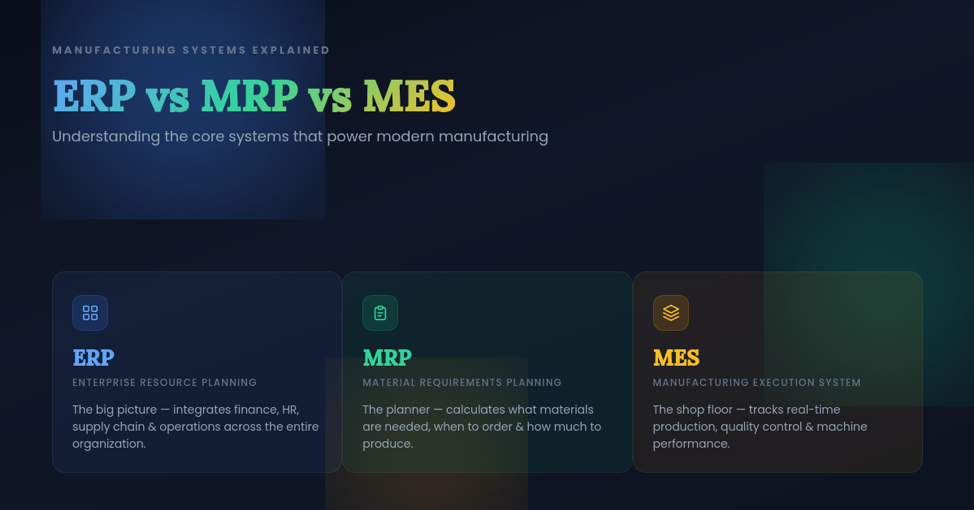
ERP manages the entire manufacturing business, MRP plans what materials you need, and MES tracks what is happening in real time on the production floor.
It seems simple. But this confusion causes real problems during evaluations. We regularly see companies investing in the wrong layer of technology because the terminology was unclear.
ERP, MRP, and MES are not interchangeable. They solve different problems. They operate at different levels of the organization. They create value in different ways.
If you are thinking or asking about “Where is the real problem in our system architecture?” “Which system out of the three do we need?” and “how do we avoid overbuying or underbuying?” you have landed at the right place. This guide explains the differences, when to choose each system, how you should integrate, and how you should sequence your decisions.
Why This Question Comes Up During Tech-Stack Evaluations
Most manufacturers begin their journey because something is breaking or unstable.
- Inventory feels unreliable.
- Production planning is manual.
- Reporting is slow.
- Margins are unclear.
- Growth is creating operational strain.
During that evaluation, vendors introduce acronyms. MRP sounds critical. MES sounds advanced. ERP sounds broad.
The mistake happens when manufacturers try to solve a planning problem with an execution system. Or try to solve a shop floor visibility issue with a financial platform.
Let’s define each clearly before we talk about when you need them.
The Three Layers of Manufacturing Technology Architecture
To understand ERP vs MES vs MRP, you need to stop thinking in product categories and start thinking in architectural layers.
Manufacturing technology operates in three structural tiers:
Tier 1: Enterprise Layer
Financial control, inventory visibility, order management, cross-functional alignment.
This is ERP.
Tier 2: Planning Layer
Demand modeling, material requirements, supply timing, production scheduling.
This is MRP.
Tier 3: Execution Layer
Machine activity, labor tracking, scrap monitoring, downtime analytics.
This is MES.
Each layer builds on the previous one.
You cannot execute cleanly without planning.
You cannot plan cleanly without accurate enterprise data.
When companies install systems out of sequence, instability multiplies.
Deep Dive: What is ERP (Enterprise Resource Planning)?
ERP is not just a system. It is the system of record for your entire organization.
It controls:
- Financial statements
- Inventory valuation
- Cost accounting
- Purchasing commitments
- Order lifecycle
- Multi-site consolidation
- Margin visibility
- Cash forecasting
Without ERP integrity:
- Finance and operations argue about numbers.
- Inventory counts differ between locations.
- Purchasing overreacts.
- Sales oversells.
- Leadership loses confidence in reporting.
ERP establishes structural discipline and is the backbone that connects finance, sales, purchasing and operations.
It forces:
- Standardized units of measure
- Defined bills of materials
- Formalized costing methods
- Controlled purchasing
Documented workflows
ERP Maturity Curve for Manufacturers
Most manufacturers move through stages:
Stage 1: Accounting System + Spreadsheets
Stage 2: Basic ERP without strong planning
Stage 3: ERP with functional MRP
Stage 4: Integrated ERP with execution visibility
Stage 5: Fully integrated ERP + MRP + MES ecosystem
The mistake is trying to jump from Stage 1 to Stage 4.
Stability precedes sophistication.
MRP: The Most Misunderstood Engine in Manufacturing
What Is MRP?
MRP stands for Material Requirements Planning. In modern manufacturing systems, MRP typically exists inside ERP. It is not a separate enterprise system. It is a planning engine.
MRP uses:
- Sales orders
- Forecasts
- Bills of materials
- Inventory levels
- Lead times
- Safety stock
MRP calculates:
- What materials are needed?
- In what quantity?
- At what time?
MRP answers:
- What should we buy?
- When should we produce?
- Will we run out of materials?
- Where are shortages coming from?
MRP makes ERP predictive instead of reactive.
However, MRP depends entirely on data quality. If bills of materials are inaccurate or lead times are unrealistic, MRP generates unreliable recommendations.
MRP does not manage financials.
MRP does not monitor machines.
MRP supports planning decisions.
Is MRP a Separate System from ERP?
In most modern cloud software platforms like Acumatica, MRP is built directly into the ERP system.
Historically, MRP began as a standalone software decades ago. Over time, as manufacturing systems evolved, MRP became integrated into ERP platforms.
Today, when a manufacturer evaluates a modern cloud ERP such as Acumatica Manufacturing Edition, MRP is not purchased separately. It operates as a core planning engine inside the ERP environment.
That means:
- MRP uses the same inventory data stored in ERP.
- MRP uses the same bills of materials configured in ERP.
- MRP generates purchase and production recommendations directly inside ERP.
- Financial impacts from production flow back into ERP automatically.
ERP is the full enterprise system. MRP is the material planning functionality inside that system.
You do not typically choose between ERP and MRP. You choose an ERP platform that includes strong MRP capabilities. However, we will still talk about the difference to make you understand the core differences between the two.
What is MES (Manufacturing Execution System)?
MES operates at the production floor level. It tracks what is happening in real time during manufacturing.
Industries where MES becomes strategic:
- Aerospace
- Automotive
- Medical device manufacturing
- Food traceability environments
- High-speed automated production
MES provides:
- Real-time OEE monitoring
- Downtime classification
- Quality capture
- Labor efficiency measurement
- Traceability depth
However, MES does not fix:
- Margin miscalculations
- Inventory valuation errors
- Forecast instability
- Purchasing inefficiencies
MES enhances execution precision.
It does not replace enterprise control.
MES answers:
What is happening on the production line right now?
Why did machine 3 stop?
What is today’s actual throughput?
Where is this job physically on the floor?
MES improves execution visibility and performance measurement.
MES does not manage financial consolidation.
MES does not calculate company-wide inventory valuation.
MES does not replace ERP.
The Core Difference in One Framework
ERP tells you how the business is performing.
MRP tells you what you will need.
MES tells you what is happening right now.
If you understand that, system selection becomes clearer.
The Cost Layering Mistake
One of the most common evaluation errors is this:
A manufacturer struggling with inventory installs MES.
Why?
Because they think visibility into production will fix accuracy.
But if ERP inventory is misaligned due to:
- Poor cycle counting
- Incorrect units
- Misconfigured BOMs
- Transaction timing issues
MES simply feeds more data into a weak foundation.
Cost layering must follow architecture.
Foundation first.
Planning second.
Execution third.
Comparison Table for Manufacturers
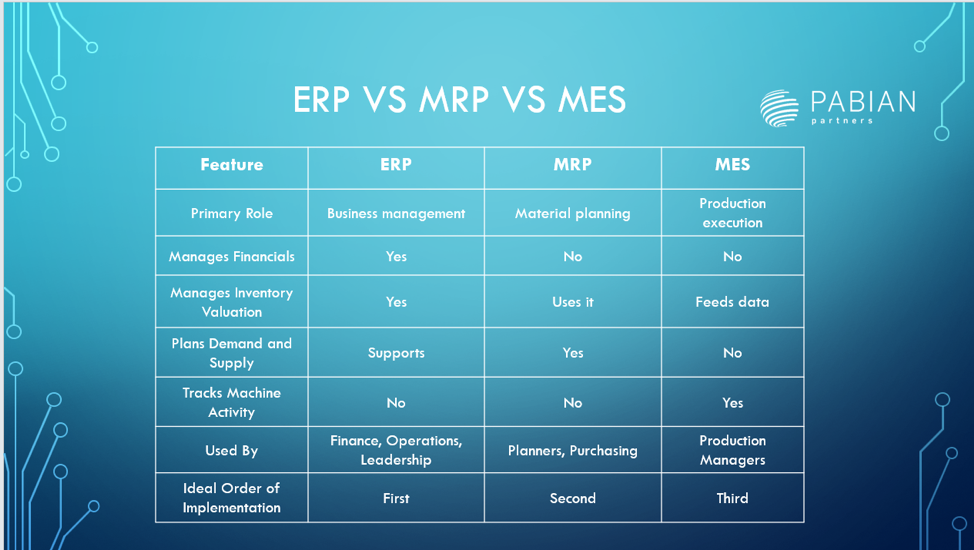
ERP vs MRP vs MES: The Difference
The Manufacturing System Decision Framework
How to Decide Between ERP, MRP, and MES Step by Step?
Before choosing any software, answer this:
Where is the real constraint in your operation?
Every manufacturing organization has one dominant bottleneck at any given stage of maturity.
The mistake is solving the wrong layer.
Step 1: Diagnose the Constraint
Ask leadership and operations the following five questions.
1. Do we trust our inventory numbers?
- If no → ERP foundation issue.
- If yes → move to next question.
2. Can we accurately forecast material needs 60–90 days out?
- If no → MRP configuration issue.
- If yes → move to next question.
3. Do we know in real time what is happening on the shop floor?
- If no → Possible MES opportunity.
- If yes → move to next question.
4. Are margins unclear or inconsistent?
- If yes → ERP costing structure issue.
- If no → move to next question.
5. Are production delays caused by planning errors or execution inefficiencies?
- Planning errors → MRP problem.
- Execution inefficiencies → MES candidate.
This diagnostic narrows the architectural layer.
Step 2: Evaluate Organizational Maturity
Software amplifies discipline. It does not create it.
Use this maturity scale:
Level 1: Reactive Operations
- Excel-based planning
- Manual purchasing
- Inventory frequently adjusted
- Limited visibility
Primary need: Modern ERP with strong MRP.
Level 2: Structured but Unstable
- ERP exists but planning is inconsistent
- Frequent overrides of MRP suggestions
- Inventory imbalances
Primary need: MRP optimization and data governance.
Level 3: Stable Planning, Limited Execution Visibility
- ERP and MRP functioning well
- Inventory stable
- Growth increasing complexity
- Limited real-time production insight
Primary candidate: MES evaluation.
Level 4: High Automation and Performance Optimization
- Multi-site operations
- Machine-level optimization impacts margin
- Regulatory traceability requirements
ERP + MRP + MES integration justified.
Step 3: Decision Matrix
If You Experience This → Choose This First
Inaccurate financial reporting → ERP
Disconnected inventory across warehouses → ERP
Manual material planning → MRP within ERP
Constant stockouts despite sufficient demand visibility → MRP configuration
High machine downtime unknown causes → MES
Need detailed OEE metrics → MES
Unclear cost per job → ERP costing structure
Difficulty scaling production → ERP foundation first
Step 4: The Sequence Rule
For most small and mid-sized manufacturers, the correct order is:
- Implement modern cloud ERP
- Stabilize inventory and costing
- Optimize MRP configuration
- Add MES if execution depth justifies investment
Skipping sequence increases risk.
Installing MES before ERP stability is like installing sensors in a house with a weak foundation.
Step 5: Financial Decision Checklist
Before approving MES, ask:
- Will machine-level visibility reduce downtime enough to justify cost?
- Is labor efficiency a primary margin driver?
- Are compliance penalties tied to traceability gaps?
- Is automation already in place?
Before upgrading ERP, ask:
- Are financial reports delayed or unreliable?
- Are inventory adjustments frequent?
- Are we managing multi-site complexity manually?
- Is growth exposing structural weaknesses?
Before investing in advanced MRP, ask:
- Are planners overriding the system constantly?
- Are lead times accurate?
- Are bills of materials clean?
- Are stockouts happening due to planning errors?
Step 6: Cost-to-Complexity Ratio
ERP complexity impacts entire organization.
MRP complexity impacts planning teams.
MES complexity impacts shop floor culture.
Cultural readiness matters.
MES often requires:
- Hardware integration
- Shop floor adoption
- Behavioral discipline
- Change management
ERP requires:
- Financial governance
- Inventory discipline
- Cross-department alignment
MRP requires:
- Data accuracy
- Forecast discipline
- Purchasing alignment
Choose based on readiness, not aspiration.
Step 7: Red Flag Indicators
Do not choose MES if:
- Inventory is inaccurate
- Bills of materials are unstable
- Costing method is unclear
- ERP reports are inconsistent
Do not rely on MRP if:
- Units of measure are inconsistent
- Lead times are guesswork
- Inventory counts are unreliable
Do not upgrade ERP without:
- Data migration discipline
- Executive sponsorship
Cross-functional ownership
In summary,
Choose ERP First If:
Inventory is unreliable.
Financial reports are inconsistent.
Multi-site visibility is unclear.
Margins are hard to calculate.
You are still using spreadsheets for core processes.
ERP stabilizes the foundation.
Focus on MRP If:
Stockouts are frequent.
Purchasing is reactive.
Planners override recommendations.
Production schedules shift constantly.
Demand forecasting feels disconnected from purchasing.
Evaluate MES If:
Machine downtime impacts margin significantly.
You need OEE tracking.
Quality traceability is critical.
Labor performance varies widely.
Execution precision drives competitiveness.
MES becomes valuable when execution-level performance materially impacts profit.
The Core Principle: Things to Keep in Mind
You may not need all three systems immediately.
You need:
The right system at the right time.
ERP is the structural layer.
MRP is the predictive layer.
MES is the performance layer.
Install them in that order unless complexity justifies otherwise.
How Pabian Partners Approaches Manufacturing System Decisions
1. Stabilize Enterprise Layer First
If financials and inventory are unstable, adding planning tools or execution systems increases noise.
We focus first on:
- Acumatica ERP foundation
- Inventory integrity
- Cost accounting structure
- Multi-site visibility
- Clean data governance
Without this, MRP features will generate chaos and MES will amplify confusion. This is because MRP depends entirely on ERP data integrity. If inventory, lead times, and bills of materials are inaccurate, the MRP engine will produce unreliable recommendations. Planning instability is usually a data governance issue, not an MRP issue.
2. Optimize the Planning Layer
Once ERP is stable, we evaluate MRP maturity.
We assess:
- Bill of materials accuracy
- Lead time realism
- Safety stock strategy
- Demand forecasting discipline
- Planner override behavior
If MRP recommendations are constantly ignored, the issue is not software. It is configuration and data. We refine the planning engine before layering complexity.
3. Evaluate Execution Layer Readiness
Only after planning stability do we ask:
Does execution precision materially affect margin?
If machine downtime, scrap rates, or compliance exposure are driving margin erosion, we evaluate MES integration. If not, we avoid unnecessary system layering.
The Difference Between Implementation and Architecture
Many firms install software.
Few architect system layers intentionally.
Pabian Partners focuses on:
- Proper sequencing
- Constraint-based diagnosis
- Cross-functional alignment
- Long-term scalability
- Avoiding unnecessary system sprawl
We guide manufacturers through:
- ERP selection
- MRP optimization
- Shop floor visibility evaluation
- Integration planning
- Phased rollouts
- Stabilization
Our role is to ensure ERP becomes a growth platform, not just a system replacement.
Why This Matters for SMB Manufacturers
Small and mid-sized manufacturers are especially vulnerable to overbuying complexity.
A common pattern:
Inventory is inaccurate.
Leadership hears about OEE.
MES looks attractive.
ERP foundation remains unstable.
The result is layered instability.
Our responsibility is to protect our customers from solving the wrong problem.
Sometimes that means recommending:
ERP first.
MRP refinement next.
MES later.
Sometimes it means saying:
You do not need MES right now.
That discipline builds long-term trust.
Where Acumatica Fits
As an Acumatica partner, we implement modern cloud ERP with strong integrated MRP.
For most SMB manufacturers, that combination stabilizes:
- Inventory
- Planning
- Costing
- Multi-site operations
- Financial visibility
Only when execution depth justifies it do we evaluate additional MES layers. Technology selection follows operational maturity.
Final Thoughts
ERP, MRP, and MES are not competing systems. They are layers.
ERP provides enterprise control.
MRP provides planning intelligence.
MES provides execution visibility.
Most manufacturers need strong ERP that has a robust MRP capability. Some need integrated MES once operational maturity supports it. Choosing correctly is not about buying the most software. It is about solving the right constraint at the right time. That is where ERP projects quietly succeed or fail.
- Why This Question Comes Up During Tech-Stack Evaluations
- The Three Layers of Manufacturing Technology Architecture
- Deep Dive: What is ERP (Enterprise Resource Planning)?
- ERP Maturity Curve for Manufacturers
- MRP: The Most Misunderstood Engine in Manufacturing
- Is MRP a Separate System from ERP?
- What is MES (Manufacturing Execution System)?
- The Core Difference in One Framework
- The Cost Layering Mistake
- Comparison Table for Manufacturers
- The Manufacturing System Decision Framework
- The Core Principle: Things to Keep in Mind
- How Pabian Partners Approaches Manufacturing System Decisions
- Final Thoughts