

Big-Bang vs Phased ERP Rollouts for Distributors: What Actually Works
- What a Big-Bang ERP Rollout Really Means
- Why Big-Bang Rollouts Appeal to Distributors
- Where Big-Bang Rollouts Break Down in Distribution
- What a Phased ERP Rollout Looks Like
- Why Phased Rollouts Work Better for Distributors
- The Role of ERP Flexibility in Rollout Strategy
- Why Partner Strategy Matters More Than Rollout Type
- When a Big-Bang Rollout Might Make Sense
- When Phased Rollouts Are the Safer Choice
- The Hidden Cost of Rushing ERP Rollouts
- ERP Rollout Strategy Should Match Business Reality
- Final Thoughts
- FAQs
One of the most important ERP decisions distributors make is not which system to buy.
It is how that system will be rolled out.
Too often, ERP implementation strategy is treated as a technical choice. In reality, it is an operational risk decision that affects warehouses, customer service, finance, and customer relationships all at once.
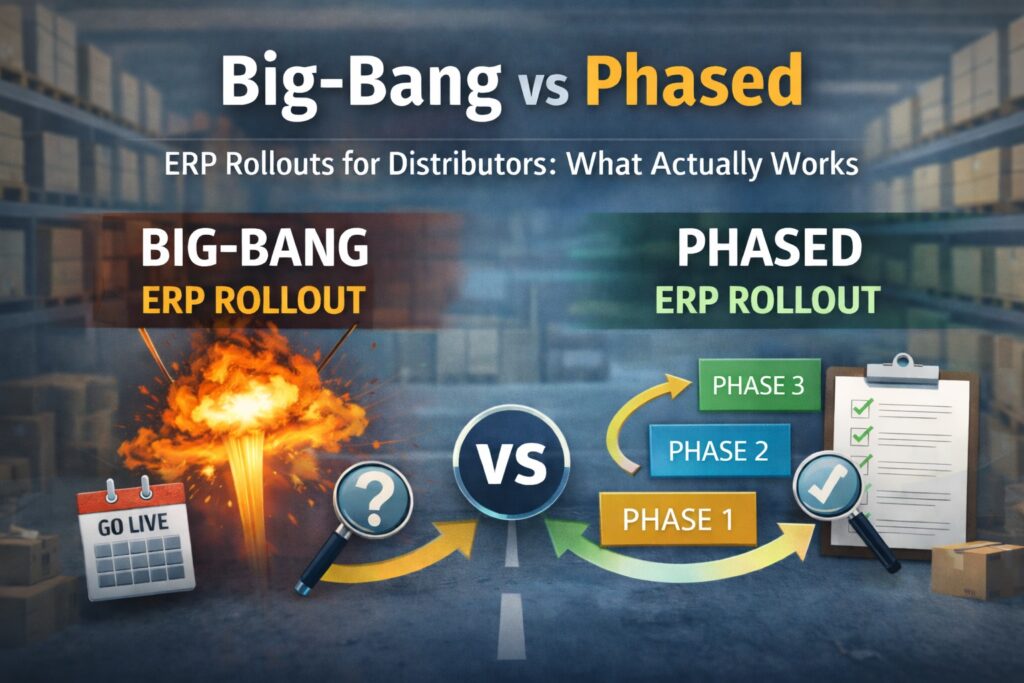
For distributors, the debate usually comes down to two approaches: big-bang or phased rollout.
Understanding the difference and choosing the right approach can determine whether ERP becomes an enabler or a disruption.
What a Big-Bang ERP Rollout Really Means
A big-bang ERP rollout means the entire organization switches to the new system at once. All core functions go live on the same day.
This typically includes:
- Order entry and fulfillment
- Inventory and warehouse operations
- Purchasing and replenishment
- Invoicing and financials
- Integrations such as EDI, eCommerce, or 3PL
On paper, big bang sounds efficient. One cutover. One go-live. One system of record.
In practice, it concentrates on risk.
Why Big-Bang Rollouts Appeal to Distributors
Big-bang implementations are often chosen for understandable reasons:
- Leadership wants a clean break from legacy systems
- There is pressure to move fast
- Maintaining two systems feels inefficient
- Vendors promise faster time to value
For small organizations with simple operations, big bang can sometimes work. But distribution is rarely simple.
Where Big-Bang Rollouts Break Down in Distribution
Distribution operations are interconnected. A breakdown in one area quickly impacts others.
Common issues during big-bang rollouts include:
- Inventory inaccuracies at go-live
- Order fulfillment delays
- Warehouse teams struggling with new workflows
- Customer service unable to answer status questions
- Finance reconciling unexpected variances
The biggest risk is not failure. It is partial failure that disrupts operations while teams scramble to stabilize.
Once orders are missed or shipments are delayed, customer trust erodes quickly.
If you are still early in your ERP journey, start with the fundamentals. Understanding what ERP is designed to solve for distributors and how different systems support inventory, fulfillment, and growth will help you evaluate options with more clarity and fewer surprises later.
What a Phased ERP Rollout Looks Like
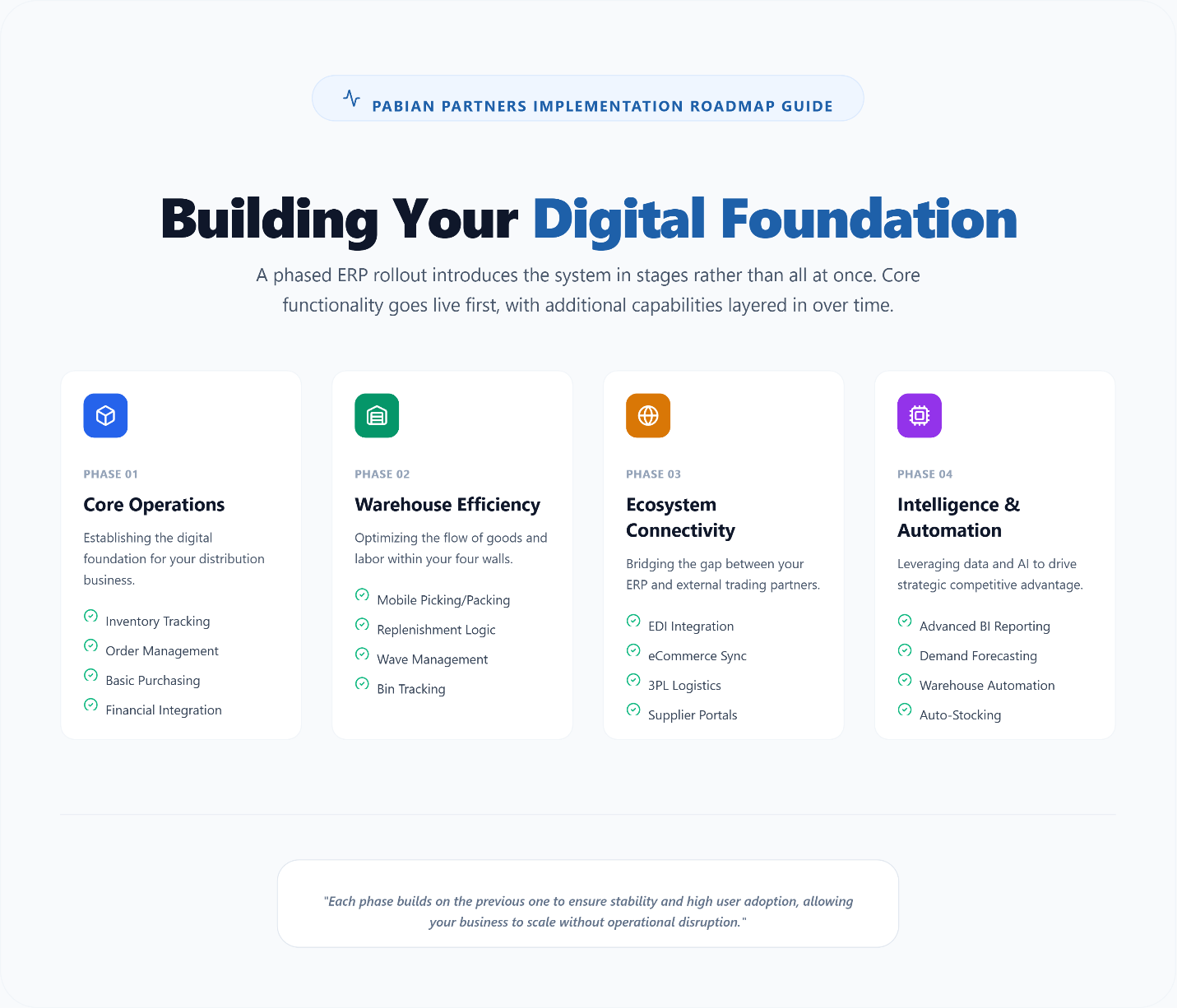
A phased ERP rollout introduces the system in stages rather than all at once. Core functionality goes live first. Additional capabilities are layered in overtime.
For distributors, a phased rollout often looks like:
- Phase 1: Core inventory and order management
- Phase 2: Warehouse workflows and replenishment automation
- Phase 3: Integrations such as EDI, eCommerce, or 3PL
- Phase 4: Advanced reporting, optimization, and automation
Each phase builds on the previous one while the business continues operating.
Why Phased Rollouts Work Better for Distributors
Phased rollouts reduce operational risk by limiting how much change happens at once.
Key benefits include:
- Lower disruption to daily operations
- Faster user adoption
- Earlier visibility into data and process issues
- Time to correct problems before expanding scope
- Reduced stress on warehouse and operations teams
Instead of overwhelming teams, phased rollouts allow ERP to earn trust gradually.
The Role of ERP Flexibility in Rollout Strategy
Not all ERP systems support phased rollouts well. Some platforms are rigid and assume everything must be live at once.
Flexible systems like Acumatica are well suited for phased approaches because modules, workflows, and integrations can be introduced incrementally without rework.
This flexibility allows distributors to align ERP rollout with operational readiness instead of forcing artificial deadlines.
Why Partner Strategy Matters More Than Rollout Type
The success of either approach depends heavily on the implementation partner.
A strong partner helps distributors:
- Identify which functions must go live first
- Define realistic phase boundaries
- Avoid over-customization early
- Use real data and real workflows during testing
- Stay engaged through stabilization and optimization
At Pabian Partners, phased rollouts are often recommended for distributors because they mirror how operations change.
Instead of forcing everything at once, the focus stays on protecting fulfillment, inventory accuracy, and customer experience.
When a Big-Bang Rollout Might Make Sense
Big-bang is not always wrong.
It may be appropriate when:
- The business is small with minimal warehouse complexity
- Transaction volume is low
- Integrations are limited or nonexistent
- Teams are highly aligned and prepared
- Operational risk is low
Even then, extensive testing and contingency planning are critical.
When Phased Rollouts Are the Safer Choice
For most distributors, phased rollouts are the safer and more sustainable option, especially when:
- Multiple warehouses are involved
- Inventory accuracy is already a concern
- EDI or customer integrations are required
- Order volume is high or seasonal
- Teams are already stretched thin
In these environments, stability matters more than speed.
The Hidden Cost of Rushing ERP Rollouts
Rushed ERP rollouts rarely save time in the long run.
Common downstream costs include:
- Emergency fixes after go-live
- Manual workarounds that become permanent
- Delayed automation and optimization
- Burned-out teams
- Loss of confidence in the system
Phased rollouts may appear slower initially, but they often deliver value sooner by avoiding chaos.
ERP Rollout Strategy Should Match Business Reality
ERP implementation is not a race. It is an operational transition.
The right rollout strategy reflects:
- How complex your operations are
- How ready your teams are for change
- How much disruption the business can absorb
- How critical customer service and fulfillment are
For distributors, protecting daily operations is usually more important than speed.
Final Thoughts
ERP success is not determined on go-live day. It is determined by how well the system supports the business once the dust settles. Big-bang rollouts concentrate risk and demand perfection under pressure. Phased rollouts spread change over time and allow teams to adapt.
For most distributors, phased ERP rollouts provide a more controlled path to stability, adoption, and long-term value. ERP works best when it is introduced at the pace your operations can sustain.
FAQs
1. How do distributors decide between big-bang and phased ERP rollouts in practice?
The decision usually comes down to operational risk. Distributors with multiple warehouses, high order volumes, or customer-driven integrations often choose phased rollouts to protect fulfillment. Simpler operations with low transaction volume may consider big-bang, but only with extensive preparation.
2. What operational signals suggest a phased ERP rollout is the safer option?
Warning signs include inconsistent inventory, manual workarounds, heavy EDI usage, seasonal order spikes, or teams already stretched thin. These conditions make it risky to change everything at once.
3. What usually breaks first in a big-bang ERP rollout?
Inventory accuracy and warehouse execution tend to break first. When pick, pack, ship, and replenishment processes change overnight, small configuration issues can quickly cascade into missed shipments and customer escalations.
4. How do phased rollouts help warehouse teams specifically?
Phased rollouts allow warehouse teams to learn new workflows gradually. Core picking, receiving, and shipping processes stabilize before additional complexity is introduced, which improves adoption and reduces error rates.
5. Can distributors run legacy systems in parallel during a phased rollout?
Yes. Many phased rollouts intentionally run legacy systems alongside ERP for specific functions or trading partners until workflows are validated. This overlap reduces cutover risk and gives teams a safety net during transition.
6. How should distributors phase ERP when EDI is involved?
EDI is often phased after core order and inventory workflows are stable. This ensures that EDI transactions are mapped against proven processes instead of introducing integration complexity too early.
7. Does phased ERP rollout mean slower time to ROI?
Not necessarily. Many distributors see value sooner because inventory visibility and order accuracy improve early. Phased rollouts reduce rework and disruption, which often accelerates usable ROI.
8. How does ERP data migration differ between big-bang and phased rollouts?
Big-bang rollouts require all data to be correct on day one. Phased rollouts allow distributors to prioritize critical data first and refine historical or secondary data later, reducing pressure and errors.
9. What role does change management play in rollout strategy?
Change management is often the deciding factor. Phased rollouts align better with how people adopt new systems, especially in operations-heavy environments like distribution where hands-on training matters.
10. How does ERP software flexibility impact rollout strategy?
Flexible ERP platforms allow functionality to be enabled incrementally without rework. This makes phased rollouts more practical and reduces the need for custom workarounds later.
11. Why do experienced partners rarely recommend big-bang rollouts for distributors?
Partners with distribution experience see firsthand how tightly connected operations are. At Pabian Partners, rollout recommendations are driven by fulfillment risk, inventory accuracy, and customer impact rather than speed or convenience.
12. How does Pabian Partners decide what goes into Phase 1?
Phase 1 is defined by what must be stable for the business to operate day to day. This usually includes core inventory, order processing, and basic warehouse workflows. Everything else is sequenced based on dependency and risk.
13. What is the biggest misconception distributors have about phased ERP rollouts?
Many believe phased rollouts are slower or less decisive. In reality, they are often more disciplined because each phase has clear success criteria before moving forward.
14. Can a distributor start with a big-bang mindset and switch to phased later?
Yes, but it is more costly to change strategy mid-project. That’s why experienced partners encourage rollout planning early, before timelines and expectations are locked in.
15. How should leadership evaluate rollout success beyond go-live?
Success should be measured by operational stability, user confidence, order accuracy, and customer experience in the weeks and months after go-live, not by hitting a single cutover date.
16. What questions should distributors ask partners about rollout strategy?
Distributors should ask how the partner handles stabilization, testing with real workflows, post-go-live support, and risk mitigation. The answers often reveal whether the partner prioritizes long-term success or short-term speed.
17. How does rollout strategy affect long-term ERP optimization?
Phased rollouts create cleaner foundations. When core processes are stable early, later automation, reporting, and optimization are easier and more effective.
18. What is the long-term cost of choosing the wrong rollout strategy?
The cost shows up as rework, stalled adoption, manual workarounds, frustrated teams, and delayed improvements. These costs are often higher than the original implementation budget.
19. Is rollout strategy more important than ERP brand?
For distributors, yes. Even the best ERP system can struggle if introduced too aggressively. Rollout strategy determines whether ERP supports the business or disrupts it.
20. What is the smartest takeaway for distributors evaluating ERP rollout options?
ERP should be introduced at the pace your operations can absorb. Stability builds trust, and trust drives adoption.
- What a Big-Bang ERP Rollout Really Means
- Why Big-Bang Rollouts Appeal to Distributors
- Where Big-Bang Rollouts Break Down in Distribution
- What a Phased ERP Rollout Looks Like
- Why Phased Rollouts Work Better for Distributors
- The Role of ERP Flexibility in Rollout Strategy
- Why Partner Strategy Matters More Than Rollout Type
- When a Big-Bang Rollout Might Make Sense
- When Phased Rollouts Are the Safer Choice
- The Hidden Cost of Rushing ERP Rollouts
- ERP Rollout Strategy Should Match Business Reality
- Final Thoughts
- FAQs